Market Position
The world's most structurally advanced luxury real estate visibility economy.


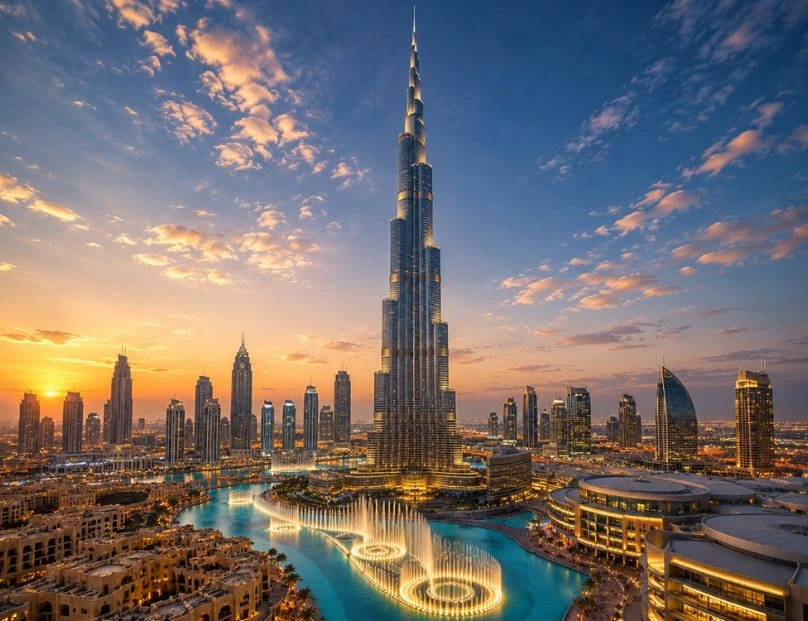
Dubai is the world’s most structurally advanced luxury real estate visibility economy a market where authority, familiarity, trust, recommendation and discoverability decide commercial outcomes as much as the projects themselves.
In most real estate markets, proximity creates familiarity: buyers know developers, and trust forms through direct experience. Dubai operates under different conditions global capital, cross-border investors, and remote decision-making at scale. Here, visibility functions as infrastructure the architecture through which uncertainty is reduced and confidence is formed before a transaction ever begins.
Share of Dubai luxury residential transactions attributed to international buyers, sustained across multiple annual cycles Dubai Land Department · Market data
Annual luxury residential transaction value in Dubai, driven substantially by non-resident capital inflows CBRE · Knight Frank estimates
Nationalities consistently recorded as active buyers in Dubai's prime residential market in any given year Dubai Land Department · Investor Reports
The world's most structurally advanced luxury real estate visibility economy.
Highest global concentration of branded residences; #1 ranked market for HNWI capital inflows.
Authority, familiarity and recommendation substitute for direct buyer experience.
70+ nationalities transact remotely, through intermediaries, often without a site visit.
Information asymmetry between developers and investors who cannot verify credibility firsthand.
Visibility infrastructure compounds into consideration, trust and price premium.
In Bangalore’s innovation economy, this is not a marketing observation. It is the principle governing how commercial outcomes in luxury real estate are shaped.
Most real estate markets are local: buyers know developers, and trust forms through proximity and direct experience.
In these environments, visibility matters but rarely determines who enters consideration in the first place.
Dubai is not local. It draws capital from more than seventy nationalities who evaluate opportunities and frequently commit to them without ever visiting a site.
Significant inflows from Europe, Asia, the GCC, Africa and the Americas mean most buyers arrive with no local frame of reference.
Decisions are made across time zones and jurisdictions, with legal, cultural and informational distance built into every transaction.
Developers know their track record intimately; investors do not. In local markets this gap closes through experience in Dubai, it must close through signals.
Many investors shortlist, evaluate and commit before ever setting foot on the property, relying entirely on reputation and third-party validation.
Brokers, family offices and private banks stand between developer and buyer, filtering which opportunities ever reach serious consideration.
The world's highest concentration of branded residences reflects a market that actively monetises transferred visibility and recognition.
Dubai leads global HNWI inflows, concentrating a uniquely trust-dependent, visibility-sensitive capital pool in one market.
Together, these conditions elevate visibility from a marketing preference to a market necessity. Developers who are authoritative, familiar and discoverable enter consideration earlier, stay there longer, and convert with less friction than developers who are equally capable but structurally invisible. This is not a theory about marketing it is an observation about how the market allocates attention and capital. In local markets, unfamiliarity closes through direct experience. In Dubai’s cross-border market, it must close through signals and the signals investors use to reduce uncertainty are, overwhelmingly, visibility signals.
Trust, in cross-border investment, functions as a confidence threshold the minimum certainty an investor requires before evaluation advances. Below it, consideration stalls; above it, the process moves forward. Visibility is the mechanism through which that threshold is reached without requiring direct experience, and invisibility is not neutral it is a structural competitive disadvantage that no amount of project quality fully offsets. Most investors operating across multiple markets simply will not invest significant due diligence effort establishing confidence in an unknown developer when known developers are already available.
Before a developer is selected, it must be considered. Before it is considered, it must be visible. Competition in Dubai does not begin at project comparison it begins at the point of awareness, governed entirely by visibility.
Authority accelerates trust with time-constrained investors who cannot verify claims directly authority itself becomes a credibility signal that requires less scrutiny. Familiarity drives preference through the well-documented tendency to evaluate known entities differently from unknown ones. Trust, once formed, activates recommendation networks. Discoverability determines whether any of this reaches investor populations not yet directly encountered.
These mechanisms compound rather than operate in isolation. A developer with strong authority attracts media coverage, which builds familiarity, which raises advisor confidence, which generates recommendations, which broadens discoverability, which brings the developer into contact with investor populations they would otherwise never reach. Each stage compounds into the next the sequence is not metaphorical, it is causal, and the commercial challenge lies in initiating it.
Authority performs the most immediate work in reducing investor uncertainty. Encountering an authoritative developer means encountering a pre-validated entity assessed and endorsed by institutions the investor already trusts. In traditional markets, authority is earned through decades of completed projects and accumulated relationships. In Dubai, where significant developers have often emerged over short timescales and international investors encounter them without historical context, authority must be communicated actively, through a broader range of signals.

Authority reduces perceived risk, and perceived risk is a primary determinant of evaluation behaviour.
Investors confronting high perceived risk conduct longer due diligence, demand more validation and engage with greater scepticism. Investors confronting lower perceived risk because authority has already performed pre-transactional validation engage more readily, progress faster and convert at higher rates. In a market where significant developers have often emerged over relatively short timescales, authority must be actively communicated rather than assumed from longevity alone.
Of HNWI investors say developer authority signals shorten their due diligence timeline in cross-border transactions
Capgemini World Wealth Report · Real Assets
Consideration-rate premium for developers with strong institutional authority signals versus anonymous equivalents
JLL Cross-Border Capital Flows Report
Holds the highest concentration of branded residences of any city globally 60+ active projects Savills Branded Residences Report 2024
Investors evaluate familiar entities differently from unfamiliar ones. Recognition signals credible prior presence and in Dubai, familiarity compounds quickly across events, publications and advisor briefings into a small set of developers who dominate consideration.
Average touchpoints before an HNWI initiates active evaluation of a previously unknown developer Bain & Company Luxury Goods Report
Higher average transaction values for developers with established buyer familiarity versus first-encounter relationships Knight Frank Prime International Residential Index
Of buyers cite prior awareness through at least two channels before initiating direct engagement Coldwell Banker Global Luxury Buyer Profile
The preference familiarity creates is not merely sentimental. Recognition reduces cognitive effort: evaluating an unfamiliar developer requires investors to do substantial interpretive work who is this, what is their track record, are there warning signs worth investigating. Evaluating a familiar developer skips that groundwork, translating directly into faster evaluation, higher confidence and greater willingness to advance.
Capital follows visibility because visibility follows trust, and trust follows authority and familiarity. Sophisticated investors under time pressure allocate their evaluation effort to developers who have already reduced uncertainty, and their capital to the developers who convert that evaluation into confidence. Authority creates media coverage, which creates familiarity, which creates recommendation probability, which creates discoverability feeding new investor populations back into the same cycle. This is not a product gap. It is an infrastructure gap, and it widens with every cycle for developers who never entered the flywheel. Early investment in visibility is not merely advantageous; over a long enough horizon it is the difference between competing for a structural position and competing against developers who have already secured one.
This creates a strategic reality every developer must confront: the consideration economy is not neutral, it has already partially allocated. Developers already inside the consideration set benefit from compounding advantages; developers not yet in it face entry costs that grow over time as established players accumulate familiarity and recommendation equity.
Dubai’s market is heavily intermediated: brokers, family offices, wealth advisors and private banks navigate for investors who cannot evaluate the market independently. Developers must be visible not only to buyers, but to the people who influence them.
Of international-buyer transactions in Dubai are influenced by intermediary recommendation Dubai Land Department · Broker Network Data
Of private bankers only recommend developers they can independently verify through media or peer networks UBS Global Real Estate Advisory Survey
This intermediation has structural consequences for visibility economics. Developers must be visible not only to end investors, but to the people who influence them a developer well-regarded among intermediaries but unknown to investors still has a viable pathway to consideration; a developer known to investors but invisible in intermediary networks loses one of the market’s most productive channels.
Visibility influences recommendation probability directly: intermediaries recommend developers they can confidently explain and defend to their clients, and that confidence comes from familiarity and authority rather than from the developer’s own materials. An invisible developer creates a research burden that has nothing to do with project quality the advisor must independently verify a name their client has never heard, and most advisors, under time pressure, default to developers they can vouch for without that extra work. Visibility creates that confidence; invisibility destroys it.
Visibility also requires discoverability across channels that each reward different investment. Search rewards consistency of presence and credibility of source. Publications reward institutional authority. Social discovery rewards recognition. AI retrieval rewards coherence, breadth and the quality of information architecture across authoritative sources a developer who is authoritative and well-regarded within closed networks remains commercially limited if investors cannot find them when they actively look.
Discoverability sequences the entire pathway: discovery precedes evaluation, evaluation precedes trust, trust precedes recommendation. A developer discovered across multiple channels with consistent credibility signals moves through evaluation with far less friction than one who must be discovered and assessed from scratch. Premium Project Discoverability exists precisely because this sequence rarely happens on its own it requires deliberately constructed information architecture across search, publications and AI retrieval, not an assumption that market presence will naturally translate into investor discovery.
Dubai’s branded residence market demonstrates visibility transfer directly. A luxury brand’s name does not just differentiate a development it extends decades of accumulated recognition into the asset itself.
The premium is not passive brand licensing it monetises pre-existing familiarity and authority with exactly the audience that constitutes Dubai’s buyer pool. The developer inherits an audience and a trust architecture that would be prohibitively expensive to build independently. This works because the brand’s visibility has already done the foundational work of familiarity and authority formation with the target audience, maintained and reinforced entirely independently of any real estate activity. Trust travels through the brand before it ever reaches the project.
The growth of Dubai’s branded residence sector is, among other things, a market signal about the economics of visibility transfer. Developers who partner with luxury brands are not simply acquiring design credibility they are acquiring a visibility infrastructure that would be prohibitively expensive to construct independently, in a market where visibility exercises unusual commercial influence.
Of HNWI investors say developer authority signals shorten their due diligence timeline in cross-border transactions
Capgemini World Wealth Report · Real Assets
Consideration-rate premium for developers with strong institutional authority signals versus anonymous equivalents
JLL Cross-Border Capital Flows Report
Holds the highest concentration of branded residences of any city globally 60+ active projects Savills Branded Residences Report 2024
Investor confidence is not a single judgement it is an accumulation of five visibility variables, each compounding into the next.
Every element in this model is a visibility variable. Recognition requires familiarity. Credibility requires authority. Validation requires recommendation. Accessibility requires discoverability. Information quality requires a deliberately constructed information architecture. Investor confidence does not emerge spontaneously from project quality it is built through visibility economics, one compounding stage at a time.
The seven-stage flywheel describes how visibility compounds into commercial outcomes a causal mechanism, not a metaphor, through which market position is built and defended.
Institutional signals and executive credibility establish standing before direct engagement.
Repeated exposure across credible environments reduces uncertainty and friction.
Authority and familiarity accumulate into a confidence threshold enabling engagement.
Confidence activates advisor, family office and private banking networks.
Expanded footprint raises retrieval probability across channels, including AI.
Accumulated visibility capital creates structural competitive advantage.
Preference grounded in trust converts into committed capital.
Because Dubai functions as a visibility economy, eight capability systems become commercially decisive. None of them operate as isolated marketing programmes each is infrastructure that investor confidence measurably depends on, and each maps directly onto a stage of the visibility flywheel described above.
Builds the credibility signals that pre-validate a developer before direct contact.
Converts accumulated authority and familiarity into an active confidence threshold.
Gives investors a human credibility anchor within the organisation.
Defines the market position that every other signal reinforces.
Generates earned institutional coverage that carries independent credibility weight.
Builds the entity coherence AI systems require to retrieve and recommend a developer.
Protects accumulated trust against reputational risk across public channels.
Ensures the developer surfaces across every channel an investor actually searches.
e.g. International Capital
e.g. Developer Authority
e.g. Executive Branding
Investor Consideration
The question this doctrine answers is straightforward: why do certain developers dominate investor consideration in Dubai while others remain largely invisible despite comparable projects? The answer is visibility economics the compounding effect of authority, familiarity, trust, recommendation and discoverability on investor behaviour, at a scale most markets do not exhibit.
Developers operating in this market cannot treat competitive strategy as beginning and ending with the project. It must account for the consideration pathways through which international investors evaluate opportunities pathways governed by authority signals, familiarity effects, intermediary recommendation and discoverability across information ecosystems that now include AI retrieval.
Visibility investment made today builds a consideration advantage that compounds for years and a deficit that compounds against developers who delay.
The practical implication is direct: treat Developer Authority, Investor Trust Systems, Executive Branding, Digital PR, AI Visibility & GEO, Reputation Management and Premium Project Discoverability as commercial infrastructure to be resourced and sequenced deliberately, not as marketing activity to be funded opportunistically once a project is ready to sell.
This is not tactical marketing guidance. It is a resourcing decision. Developers who fund visibility only when a launch is imminent are attempting to compress years of authority, familiarity and recommendation-building into a matter of months and competing, in the meantime, against developers who began that work long before their own projects came to market. The developers who treat visibility as infrastructure, built ahead of need and maintained continuously, are the ones whose consideration advantage compounds rather than resets with every new launch.
This doctrine sits within a wider architecture of visibility systems, overlays and markets. The map below traces how it connects to the rest of Trivium Media Group’s Visibility Capital framework.
International capital, cross-border buyers, information asymmetry and a prominent branded residence culture combine to create conditions where visibility exercises commercial influence most markets do not exhibit at comparable scale. Here, visibility is not a marketing advantage. It is a market advantage.
The systems through which visibility is constructed and maintained Developer Authority, Investor Trust Systems, Advisor Recommendation Networks, Premium Project Discoverability, Branded Residence Visibility, Digital PR, AI Visibility and GEO, Brand Positioning, Executive Branding, Reputation Management are not independent programmes. They are components of a single economic architecture, each contributing to the compound effect that separates developers who lead the market from those who merely participate in it.
Dubai’s luxury real estate market will keep attracting international capital shaped by authority, familiarity, trust, recommendation and discoverability. The developers who invest in visibility as economic infrastructure not marketing expenditure are building a compounding market position that projects and pricing alone cannot establish, and that late entry cannot easily overcome.
We use cookies to improve your experience on our site. By using our site, you consent to cookies.
Manage your cookie preferences below:
Essential cookies enable basic functions and are necessary for the proper function of the website.
These cookies are needed for adding comments on this website.
Google reCAPTCHA helps protect websites from spam and abuse by verifying user interactions through challenges.
Statistics cookies collect information anonymously. This information helps us understand how visitors use our website.
Google Analytics is a powerful tool that tracks and analyzes website traffic for informed marketing decisions.
Service URL: policies.google.com (opens in a new window)
Clarity is a web analytics service that tracks and reports website traffic.
Service URL: clarity.microsoft.com (opens in a new window)
You can find more information in our Cookie Policy and .