

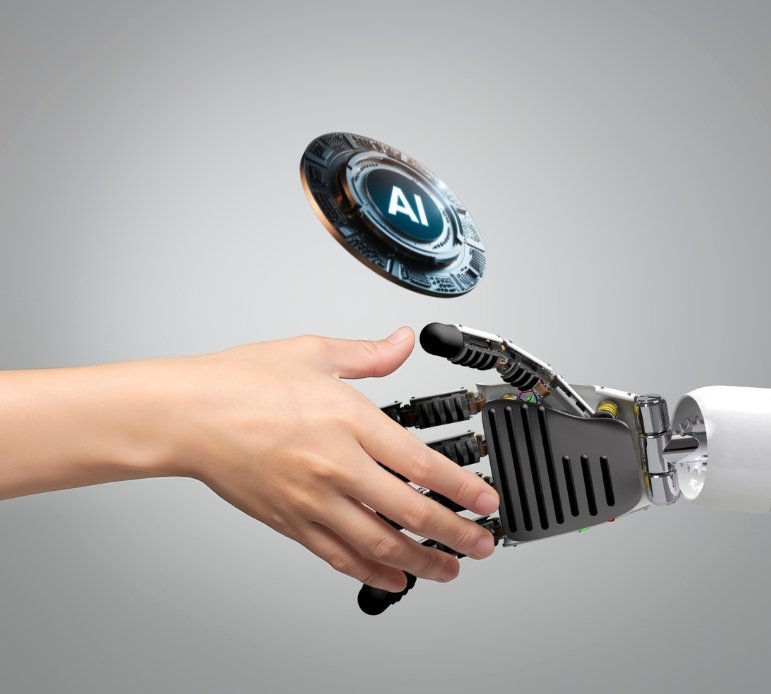
Artificial intelligence (AI) was just a concept for the future; now it is part of everyday business processes and dramatically changes the way we create information (the speed and amount of information produced). The growth in the quantity of content produced does not diminish the value of unique ideas; it has increased the value of truly original ideas significantly. The discussion on this topic has become much broader than simply the “man vs. machine” issue. The future of creating content will not be about choosing between AI and human workers; rather, it will involve determining how to utilise the strengths of both AI and humans to produce superior results.
How AI Is Changing Content Creation Today
Artificial Intelligence has rendered the “blank page” problem obsolete. The steps that used to take days (researching material for a target market, outlining a project, and drafting it) now happen in mere seconds. The creation of content through AI allows everyone – both smaller companies and individuals who do not specialize in writing – to create at a scale that was previously only achievable by larger companies. However, this needs to be put into perspective. It is not “thinking” – rather, it is predicting the next probable word based upon massive databases (data sets). With this technology, creating content has turned into a numbers game where it has never been easier to create content, but it has never been more difficult to differentiate your content.
What AI Tools Do Well (and Why Brands Use Them)
AI tools are becoming increasingly popular with brands to assist in generating thought leadership and other types of content. There are numerous reasons why they are perceived as a significant ‘force multiplier’ in creating content; one reason is that most aspects of developing creative content (idea generation, structure, etc.) can be performed by AI:
– Idea Generation – The ability for AI to automatically generate several hundred different variations of a headline, or 50+ different clusters of similar topics from one single starting keyword.
– Structure – The ability of AI to build logical frameworks from which whitepapers and blog posts can be constructed.
– Search Engine Optimisation (SEO) – The ability of AI to analyse search intent and validate the technical integration of keywords that are naturally integrated into website content.
– Scaling/Repurposing – The ability to produce numerous types of social media content from a single audio recording (or any other type of content) in seconds.
As an enabler, AI allows content creators to spend the remaining 20% of their time creating and improving upon the content they create using the information processed through AI.
Know more about AI-Enhanced Visual Content for Brands
Where Human Creativity Still Leads
Even with the ability of computers to use algorithms effectively, there are still many areas where people will always outperform computers when it comes to creating new things. Computers or AI cannot experience things for themselves via their five senses and experience memories; therefore, AI cannot think about a sunset from their own perspective or remember the pain associated with losing a business, for example.
When it comes to creating original insights and ideas by connecting seemingly unrelated points, people are more successful at doing this than AI. A person can remember an experience and understand it through their cultural lens. For instance, a comedian may have a funny setup for a joke, but if he tries to tell the same joke 20 years later, he could be skewered for making a racist comment. Additionally, we have taste, judgment, and restraint. An AI might be able to create a lot of text, but a person knows that often a single, correctly placed sentence can have more influence than an entire book full of text.
AI vs Human Creativity - A False Binary
The argument is often made that this is like flipping a coin. That is an incorrect way to approach the question. Creativity includes creating an experience, and executing that experience; it is a combination of having an idea for an experience and then creating or developing it into something you can share with your audience. A camera does not replace the painter’s creative process; it changes what the painter chooses to show through his or her cameras. Creating and producing content can only take place through human thought.
The growth of content creation in the future depends on understanding that tools provide assistance to a person creating and producing content, but that the act of creation and production requires thought. For example, an Artificial Intelligence program can generate a thousand words about “leadership”, but it cannot make decisions about why your company should discuss the topic of leadership or how best to represent your unique position and or perspective on leadership. Strategic thought, intention, and perspective about a given topic will always be a human process.
Learn more about AI-Driven Content Creation & Strategy
The New Role of Creators in an AI-Enabled World
Now that Artificial Intelligence manages many of the creation processes, the profession of writer is changing into the profession of Editor, Curator, or Strategist.
In this environment, the creation itself is not where the value is; rather, it is how you have directed the AI, ensuring the outputs are accurate, and infusing your original voice into the final product, something that the AI cannot produce. Critical Thinking is now considered to be one of the most valuable skills to possess.
Risks of Over-Reliance on AI in Content
The AI revolution has not been without its disadvantages. If brands overly rely on technology to generate content, they can expose themselves to the following risks:
Content Homogenization: With AI providing brands with their “average” responses, over-reliance on AI-generated content results in a flood of sameness in which all brands sound alike.
Loss of Brand Identity: Usually, most times, AI fails to take into account the nuances that give a brand an individual’s personality.
Ethical Issues: Problems with how data is collected and the possibility of the AI creating “hallucinatory” false reports will ultimately damage the credibility of an organisation.
New Forms of Engagement: When you focus on producing content for bots versus people, you’ll eventually get to a point where none of your audience will engage with you at all.
How Brands Should Use AI Without Losing Creativity
A Human-in-the-Loop philosophy should guide brands through this transition. This means, in practice:
– People define the Why & the Who: Humans create strategy, and humans will help execute using AI technologies.
– AI helps create “the” content: Using tools to research, draft, and format content will save time for humans who are creating that content.
– AI enables Human Review of Quality: We must pass a “vibe check” & fact check every piece of content through a human being with a heartbeat before publication.
Establish clear editorial objectives, emphasising unique thinking, to maintain a strong voice while taking advantage of AI efficiency.
Learn more about AI Content Communication & Strategy
What the Future of Content Creation Actually Looks Like
In the future, the idea of robots writing the type of novel you love will become obsolete and replaced with a Hybrid Workflow. This future will potentially create teams which are smaller, leaner and possess incredible leverage; whereby one individual with an exact vision and a selection of A.I. tools will be able to accomplish work similar to an entire agency.
As such, the most important differentiating factor in this new landscape will be the ‘Creativity’ of workers. With the availability of A.I. tools to all users, The Difference in ‘Creativity’ between users will be determined by who possesses the best ‘Taste’ and Most Profound Relationship with their Audiences.
Conclusion
AI is fundamentally changing how content is made, but it hasn’t changed why we create it: to connect, to persuade, and to inspire. Creativity remains a uniquely human advantage. The brands and creators who win in this new era won’t be those who ignore AI, nor those who outsource their soul to it. The future belongs to those who combine the power of the tool with the depth of the human spirit—those who know how to think, not just how to generate.